Notice GiBiDi BE12
Produit concerné
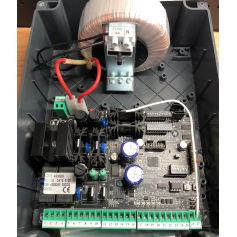
BE12 - (AS06260)
Apparecchiatura elettronica — Istruzioni per l'installazione
Electronic control unit — Instructions for installation
Platine électronique — Instructions pour l'installation
Equipo electrónico — Instrucciones para la instalación
IT — Italiano
1 - Caratteristiche tecniche
| Apparecchiatura | BE12 / AS06260 |
|---|---|
| Tipo | Apparecchiatura elettronica per l'automazione di un cancello battente a doppia anta con motori a 12Vdc |
| Alimentazione | 230 Vac monofase 50/60 Hz |
| N° motori | 1-2 |
| Alimentazione motore | 12 Vdc |
| Lampeggiante | 12 Vdc 10W max |
| Alimentazione accessori | 12 Vdc 10W max |
| Ricevitore radio | Integrato, massimo 200 radiocomandi |
| Temperatura di utilizzo | -20°C +60°C |
| Tempo di lavoro | TEMPO |
2 - Caratteristiche tecniche / Funzioni
- Led rossi di segnalazione dei contatti N.C. e per la memorizzazione dei trasmettitori.
- Led blu per la programmazione dei tempi.
- Pulsanti a bordo scheda per la programmazione e per l'apprendimento dei radiocomandi.
- Apprendimento dei tempi di lavoro automatico, con procedura semplificata.
- Ricevente radio a bordo che può memorizzare fino a 200 radiocomandi.
- Gestione dei canali dei radiotrasmettitori tramite dip switch.
- Rallentamento in apertura e chiusura.
- Velocità rallentamento e movimento regolabile tramite dip switch.
- Arresto ed inversione del moto dopo l'intervento dei dispositivi di sicurezza.
- Lettura amperometrica dell'assorbimento del motore, regolabile tramite dip switch.
- Funzionamento pedonale con apertura anta 1.
- 2 ingressi N.C. fotocellula 1, fotocellula 2.
- 1 Ingresso (SAFETY) programmabile tramite dip switch come STOP o COSTA.
- 2 possibili logiche di funzionamento: passo passo con stop o condominiale selezionabile tramite dip switch.
- Tempo sfasamento ante regolabile tramite dip switch.
- Programmazione della richiusura automatica e del tempo di pausa tramite dip switch.
- Predisposizione per uso con batterie tampone.
- Soft-Start e Soft-Stop per limitare gli shock meccanici.
Grazie per avere scelto GIBIDI.
LEGGERE ATTENTAMENTE QUESTO MANUALE PRIMA DI PROCEDERE ALL'INSTALLAZIONE.
AVVERTENZE: Questo prodotto è stato collaudato in GI.BI.DI. verificando la perfetta corrispondenza delle caratteristiche alle direttive vigenti. GI.BI.DI. S.r.l. si riserva la facoltà di modificare i dati tecnici senza avviso, in funzione dell'evoluzione del prodotto.
SMALTIMENTO: GI.BI.DI. consiglia di riciclare i componenti in plastica e di smaltire in appositi centri abilitati i componenti elettronici evitando di contaminare l'ambiente con sostanze inquinanti.
3 - Avvertenze per l'installazione
- Prima di procedere con l'installazione bisogna predisporre a monte dell'impianto un interruttore magneto termico e differenziale con portata massima 10A. L'interruttore deve garantire una separazione omnipolare dei contatti, con distanza di apertura di almeno 3 mm.
- Per evitare possibili interferenze, differenziare e tenere sempre separati i cavi di potenza (sezione minima 1,5mm²) dai cavi di segnale (sezione minima 0,5mm²).
- Eseguire i collegamenti facendo riferimento alle tabelle seguenti e alla serigrafia allegata. Fare molta attenzione a collegare in serie tutti i dispositivi che vanno collegati allo stesso ingresso N.C. (normalmente chiuso) e in parallelo tutti i dispositivi che condividono lo stesso ingresso N.O. (normalmente aperto). Una errata installazione o un uso errato del prodotto può compromettere la sicurezza dell'impianto.
- Tutti i materiali presenti nell'imballo non devono essere lasciati alla portata dei bambini in quanto potenziali fonti di pericolo.
- Il costruttore declina ogni responsabilità ai fini del corretto funzionamento dell'automazione nel caso non vengano utilizzati i componenti e gli accessori di propria produzione e idonei per l'applicazione prevista.
- Al termine dell'installazione verificare sempre con attenzione il corretto funzionamento dell'impianto e dei dispositivi utilizzati.
- Questo manuale d'istruzioni si rivolge a persone abilitate all'installazione di "apparecchi sotto tensione" pertanto si richiede una buona conoscenza della tecnica, esercitata come professione e nel rispetto delle norme vigenti.
- La manutenzione deve essere eseguita da personale qualificato.
- Prima di eseguire qualsiasi operazione di pulizia o di manutenzione, scollegare l'apparecchiatura dalle rete di alimentazione elettrica.
- L'apparecchiatura qui descritta deve essere utilizzata solo all'uso per il quale è stata concepita.
- Verificare lo scopo dell'utilizzo finale e assicurarsi di prendere tutte le sicurezze necessarie.
- L'utilizzo dei prodotti e la loro destinazione ad usi diversi da quelli previsti, non è stata sperimentata dal costruttore, pertanto i lavori eseguiti sono sotto la completa responsabilità dell'installatore.
- Segnalare l'automazione con targhe di avvertenza che devono essere visibili.
- Avvisare l'utente che bambini o animali non devono giocare o sostare nei pressi del cancello.
- Proteggere adeguatamente i punti di pericolo (per esempio mediante l'uso di una costa sensibile).
4 - Avvertenze per l'utente
- In caso di guasto o anomalie di funzionamento staccare l'alimentazione a monte dell'apparecchiatura e chiamare l'assistenza tecnica. Verificare periodicamente il funzionamento delle sicurezze. Le eventuali riparazioni devono essere eseguite da personale specializzato usando materiali originali e certificati.
- Il prodotto non deve essere usato da bambini o persone con ridotte capacità fisiche, sensoriali o mentali, oppure mancanti di esperienza e conoscenza, a meno che non siano stati correttamente istruiti.
- Non accedere alla scheda per regolazioni e/o manutenzioni.
ATTENZIONE: IMPORTANTI ISTRUZIONI DI SICUREZZA. E' importante per la sicurezza delle persone seguire queste istruzioni. Conservare il presente libretto di istruzioni.
5 - Collegamenti elettrici: Faston
| FASTON | Descrizione |
|---|---|
| CF1 | 0 Vac da trasformatore |
| CF2 | 12 Vac da trasformatore |
6 - Collegamenti elettrici: Morsettiere
| Morsetto | Posizione | Segnale | Descrizione |
|---|---|---|---|
| M1 | 1 | M1+ | Motore 1+ |
| M1 | 2 | M1- | Motore 1- |
| M1 | 3 | M2+ | Motore 2+ |
| M1 | 4 | M2- | Motore 2- |
| M2 | 5 | EL+ | + Alimentazione elettroserratura 12V. |
| M2 | 6 | EL- | - Alimentazione elettroserratura 12V. |
| M2 | 7 | LAMP/SPIA | + Alimentazione LAMPEGGIANTE/SPIA 12Vdc 10W MAX. |
| M2 | 8 | LAMP/SPIA | - Alimentazione LAMPEGGIANTE/SPIA 12Vdc 10W MAX. |
| M2 | 9 | +ACC | +12Vdc Alimentazione accessori esterni MAX 10W. |
| M2 | 10 | -ACC | Comune alimentazione accessori esterni MAX 10W. |
| M3 | 11 | 5V | INUTILIZZATO |
| M3 | 12 | S1 | INUTILIZZATO |
| M3 | 13 | COM | INUTILIZZATO |
| M3 | 14 | 5V | INUTILIZZATO |
| M3 | 15 | S2 | INUTILIZZATO |
| M3 | 16 | COM | INUTILIZZATO |
| M4 | 17 | START | Ingresso START (N.O.). |
| M4 | 18 | PED | Ingresso PEDONALE (N.O.) (DIP 2_7) |
| M4 | 19 | PHOTO 1 | Ingresso FOTOCELLULA 1 (N.C.) attiva solo in chiusura. Quando viene intercettata durante la chiusura inverte immediatamente il moto in apertura. In apertura è ininfluente. In pausa ricarica il tempo di pausa. |
| M4 | 20 | PHOTO 2 | Ingresso FOTOCELLULA2 (N.C.) attiva in apertura e chiusura. Quando viene intercettata blocca i motori in attesa del rilascio. Al ripristino del contatto di PHOTO2 il cancello si muove in apertura. In pausa ricarica il tempo di pausa. |
| M4 | 21 | STOP / SAFETY | Ingresso programmabile (STOP– COSTA). |
| M4 | 22 | COM | Comune ingressi. |
| M4 | 23 | COM | Comune ingressi. |
| M4 | 24 | IN1 | Ingresso non utilizzato. |
| M4 | 25 | IN2 | Ingresso non utilizzato. |
| M5 | 26 | COM | Ingresso calza antenna. |
| M5 | 27 | ANT | Ingresso segnale antenna. |
| M6 | 28 | +BAT | +Batteria 12V MAX 3Ah. |
| M6 | 29 | -BAT | -Batteria 12V MAX 3Ah. |
7 - Fusibili di protezione
| Posizione | Valore | Tipo | Descrizione |
|---|---|---|---|
| F1 | 10A | F | Protegge l'alimentazione batteria 12V. |
| F2 | 3,15A | F | Protegge gli accessori esterni, l'elettroserratura e il lampeggiante. |
| F3 | 8A | F | Protegge la scheda elettronica. |
| F4 | 2A | F | Protegge il trasformatore. |
8 - Led di segnalazione
| Posizione | Colore | Segnale | Descrizione |
|---|---|---|---|
| L1 | VERDE | START | Si accende quando viene attivato il comando START dalla morsettiera o dalla ricevente. |
| L2 | VERDE | PED | Si accende quando viene attivato il comando PED dalla morsettiera o dalla ricevente. |
| L3 | ROSSO | PHOTO1 | Sempre acceso, si spegne quando viene aperto il contatto del morsetto PHOTO1. |
| L4 | ROSSO | PHOTO2 | Sempre acceso, si spegne quando viene aperto il contatto del morsetto PHOTO2. |
| L5 | ROSSO | SAFETY | Sempre acceso, si spegne quando viene rilevato un valore non corretto sul morsetto SAFETY. |
| L6 | ROSSO | RX | SEMPRE spento. Si accende quando viene premuto il pulsante LEARN per memorizzare un nuovo TX o per cancellare tutti i TX. |
| L7 | BLU | INFO | 0,2s ON / 0,2 OFF: La centrale è bloccata in attesa di effettuare il ciclo di apprendimento. E' necessario eseguire il ciclo di apprendimento. 30s ON: La centrale è in fase di pre apprendimento in seguito all'attivazione del pulsante memo. 0,2s ON-4s OFF: A riposo, la centrale è impostata per il funzionamento con operatore MODO12-MEKABL12-ART3012. 0,2s ON-0,2s OFF / 0,2s ON-4s OFF: A riposo, la centrale è impostata per il funzionamento con operatore FLOOR812. |
9 - Dip switch DIP1
Le impostazioni vengono memorizzate durante la fase di riposo (cancello chiuso). Le impostazioni di DEFAULT sono evidenziate con lo sfondo della casella in grigio.
| DIP | Funzione | Stato | Descrizione |
|---|---|---|---|
| 1_1 | CONDOMINIALE | ON | Funzionamento in risposta al comando di START: Cancello chiuso → APRE; Durante l'apertura → ININFLUENTE; Cancello aperto → Ricarica il tempo di chiusura automatica se la richiusura automatica è abilitata altrimenti chiude; Durante la chiusura → APRE. |
| 1_1 | PASSO – PASSO CON STOP | OFF | Funzionamento in risposta al comando di START: Cancello chiuso → APRE; Durante l'apertura → STOP; Cancello aperto → CHIUDE; Durante la chiusura → STOP; Dopo uno STOP → inverte il moto. |
| 1_2 | MORSETTO 21 COME COSTA | ON | Funzionamento: Cancello chiuso → ININFLUENTE; Durante l'apertura → Inversione immediata del moto per 2s rallentando e, a liberazione del contatto, inversione totale con moto rallentato; Cancello aperto → ININFLUENTE; Durante la chiusura → Inversione immediata del moto per 2s rallentando e, a liberazione del contatto, inversione totale con moto rallentato. |
| 1_2 | MORSETTO 21 COME STOP | OFF | Funzionamento: Cancello chiuso → ININFLUENTE; Durante l'apertura → STOP; Cancello aperto → STOP, no richiusura automatica; Durante la chiusura → STOP; Dopo uno STOP → inverte il moto. |
| 1_3 / 1_4 | SOGLIA AMPEROMETRICA STOP MOTORE | OFF/OFF | Sensibilità molto elevata. |
| 1_3 / 1_4 | OFF/ON | Sensibilità elevata. | |
| 1_3 / 1_4 | ON/OFF | Sensibilità media. | |
| 1_3 / 1_4 | ON/ON | Sensibilità bassa. | |
| 1_5 / 1_6 | TEMPO PAUSA | OFF/OFF | Chiusura automatica disabilitata. |
| 1_5 / 1_6 | OFF/ON | 10 secondi. | |
| 1_5 / 1_6 | ON/OFF | 30 secondi. | |
| 1_5 / 1_6 | ON/ON | 60 secondi. | |
| 1_7 | PRELAMPEGGIO | ON | Abilita il prelampeggio di 3 secondi prima dell'attivazione del motore in apertura e chiusura. |
| 1_7 | OFF | Prelampeggio disabilitato. | |
| 1_8 / 1_9 | TEMPO SFASAMENTO ANTA | OFF/OFF | Sfasamento ante disattivato. |
| 1_8 / 1_9 | OFF/ON | Ritardo motore 2 in apertura: 3 secondi. Ritardo motore 1 in chiusura: 3 secondi. | |
| 1_8 / 1_9 | ON/OFF | Ritardo motore 2 in apertura: 3 secondi. Ritardo motore 1 in chiusura: 6 secondi. | |
| 1_8 / 1_9 | ON/ON | Ritardo motore 2 in apertura: 3 secondi. Ritardo motore 1 in chiusura: 9 secondi. | |
| 1_10 | COLPO D'ARIETE | ON | Abilita la funzione colpo d'ariete in apertura per favorire lo sgancio dell'elettroserratura. Funzionamento: al comando di START, si avrà in sequenza: attivazione dell'elettroserratura; impulso in chiusura di 1 s; apertura; dopo 2 s sgancio dell'elettroserratura. |
| 1_10 | OFF | Disabilita la funzione colpo d'ariete. |
10 - Dip switch DIP2
Le impostazioni vengono memorizzate durante la fase di riposo (cancello chiuso). Le impostazioni di DEFAULT sono evidenziate con lo sfondo della casella in grigio.
| DIP | Funzione | Stato | Descrizione |
|---|---|---|---|
| 2_1 | VELOCITA' RALLENTAMENTO (il cambio di impostazione resetta la centrale ed è necessario eseguire un nuovo ciclo di apprendimento) | ON | Velocità rallentamento uguale al 50% della velocità massima. |
| 2_1 | OFF | Velocità rallentamento uguale al 30% della velocità massima. | |
| 2_2 | VELOCITA' MOVIMENTO (il cambio di impostazione resetta la centrale ed è necessario eseguire un nuovo ciclo di apprendimento) | ON | Velocità movimento uguale al 100% della velocità massima. |
| 2_2 | OFF | Velocità movimento uguale al 80% della velocità massima. | |
| 2_3 | CHIUSURA RAPIDA CON PHOTO 1 | ON | Chiusura rapida attivata. In seguito all'intercettazione e alla liberazione di PHOTO1, il tempo di pausa è ridotto a 3 secondi. |
| 2_3 | OFF | Chiusura rapida disabilitata. | |
| 2_4 | INUTILIZZATO | ON/OFF | — |
| 2_5 | INUTILIZZATO | ON/OFF | — |
| 2_6 | SPIA / LAMPEGGIANTE | ON | Utilizzo delle uscite M2-7 e M2-8 come LUCE SPIA, sempre accesa fissa con cancello aperto. |
| 2_6 | OFF | Utilizzo delle uscite M2-7 e M2-8 come LAMPEGGIATORE, acceso lampeggiante con i motori attivi. | |
| 2_7 | FUNZIONAMENTO MORSETTO 18 | ON | Il morsetto 18 funziona come ingresso START ma non eseguirà la chiusura automatica anche se abilitata. |
| 2_7 | OFF | Il morsetto 18 funziona come ingresso PEDONALE. La manovra pedonale è eseguita con logica condominiale sull'anta 1 e non è modificabile. La chiusura automatica è attiva se è attiva la chiusura automatica generale. | |
| 2_8 | COLPO FINALE IN CHIUSURA | ON | Abilita la funzione colpo finale in chiusura. Funzionamento: dopo il rallentamento, il moto prosegue per 1s per facilitare l'aggancio dell'elettroserratura. Durante il colpo finale in chiusura non sono attive le sicurezze ed i comandi (PHOTO, COSTA, START, etc.) |
| 2_8 | OFF | Disabilita la funzione colpo finale in chiusura. | |
| 2_9 | DISTANZA RALLENTAMENTO (il cambio di impostazione resetta la centrale ed è necessario eseguire un nuovo ciclo di apprendimento) | ON | Rallentamento lungo (~33% della corsa totale). Ininfluente se DIP2_4=OFF. |
| 2_9 | OFF | Rallentamento breve (~25% della corsa totale). | |
| 2_10 | INUTILIZZATO | — |
11 - Jumper SW4
Le impostazioni vengono memorizzate durante la fase di riposo (cancello chiuso). Le impostazioni di DEFAULT sono evidenziate con lo sfondo della casella in grigio.
| JUMPER | Funzione | Descrizione |
|---|---|---|
| SW4 | FUNZIONAMENTO MORSETTO 21 | Posizione aperta: All'ingresso STOP/COSTA (21) sono collegati dispositivi di tipo N.C. Posizione chiusa: All'ingresso STOP/COSTA (21) sono collegati dispositivi di tipo resistivo 8,2KOhm (8K2). |
12 - Dip switch DIP3
E' necessario spegnere e riaccendere l'apparecchiatura per memorizzare le nuove impostazioni dei dip. Le impostazioni di DEFAULT sono evidenziate con lo sfondo della casella in grigio.
| DIP | Funzione | Stato | Descrizione |
|---|---|---|---|
| 3_1 / 3_2 | ASSEGNAZIONE COMANDO DI START | OFF/OFF | Ingresso START associato al pulsante 1 del trasmettitore. |
| 3_1 / 3_2 | OFF/ON | Ingresso START associato al pulsante 2 del trasmettitore. | |
| 3_1 / 3_2 | ON/OFF | Ingresso START associato al pulsante 3 del trasmettitore. | |
| 3_1 / 3_2 | ON/ON | Ingresso START associato al pulsante 4 del trasmettitore. | |
| 3_3 / 3_4 | ASSEGNAZIONE COMANDO PEDONALE (se l'impostazione è uguale a DIP3_1 e DIP3_2, il PEDONALE è disabilitato) | OFF/OFF | Ingresso PED associato al pulsante 1 del trasmettitore. |
| 3_3 / 3_4 | OFF/ON | Ingresso PED associato al pulsante 2 del trasmettitore. | |
| 3_3 / 3_4 | ON/OFF | Ingresso PED associato al pulsante 3 del trasmettitore. | |
| 3_3 / 3_4 | ON/ON | Ingresso PED associato al pulsante 4 del trasmettitore. | |
| 3_5 | INUTILIZZATO | OFF | Tenere OFF, non modificare. |
| 3_6 | INUTILIZZATO | ON/OFF | — |
13 - Gestione ricevente radio a bordo
Memorizzazione nuovo trasmettitore:
- Premere e rilasciare il pulsante Learn.
- Il led L6 si accenderà.
- Premere il tasto 1 del radiocomando da memorizzare per 2 secondi.
- Il nuovo radiocomando è memorizzato.
- Il led L6 resterà acceso per altri 5 secondi, durante questo periodo è possibile memorizzare altri trasmettitori ripartendo dal punto 3.
E' possibile memorizzare fino a 200 radiocomandi.
Cancellazione totale della memoria:
- Premere e tenere premuto il pulsante Learn per 12 secondi.
- Il led L6 inizialmente si accenderà e si spegnerà trascorsi i 12 secondi.
- Tutti i trasmettitori sono stati cancellati.
Assegnazione dei comandi di START e PED ai pulsanti dei trasmettitori: Fare riferimento a fig.17-18 e configurazione DIP3.
14 - Apprendimento corsa
La procedura è divisa in due fasi, completamente automatiche, la prima di apprendimento degli SPAZI DI APERTURA E CHIUSURA e la seconda di apprendimento dei valori amperometrici dei motori.
In caso di utilizzo di un solo motore, questo deve essere collegato ai morsetti M1. L'intervento di qualsiasi dispositivo; START, PED, PHOTO1, PHOTO2, SAFETY durante la fase di apprendimento comporta l'interruzione e l'uscita dal ciclo di apprendimento e sarà necessario ripeterlo. Durante la fase di apprendimento il lampeggiatore/SPIA sarà acceso con luce fissa. L'apprendimento della corsa avviene a velocità rallentata 50%. Assicurarsi che la centrale sia alimentata con tensione di rete 230V, con funzionamento a batteria non è possibile eseguire la procedura di apprendimento.
Procedura di apprendimento:
- Sbloccare gli operatori e portare le ante a metà corsa.
- Bloccare gli operatori.
- Verificare la presenza dei fermi meccanici a terra e/o sull'operatore in apertura e chiusura.
- Rimuovere eventuali ostacoli nel raggio d'azione dell'automazione.
- Verificare che i led L3, L4, L5 e L8 siano accesi.
- Premere il pulsante MEMO.
- Il led L7 si accenderà e resterà acceso per 30 secondi dopodiché la centrale uscirà dalla funzione auto apprendimento.
- Entro i 30 secondi (led L7 acceso) scegliere con il pulsante MEMO il tipo di motore da utilizzare. La prima pressione del pulsante attiverà la selezione del motore MODO12-MEKA BL12-ART3012 e il led L7 farà un lampeggio, la seconda pressione del pulsante MEMO attiverà la scelta del motore FLOOR812 e il led L7 farà due lampeggi. La sequenza continuerà ciclicamente ad ogni pressione del pulsante MEMO.
- Ora premere il tasto 1 (START) del radiocomando o dare un impulso di START da morsettiera.
- Verificare che il movimento dei motori sia nel verso corretto (inizialmente in apertura). In caso contrario bloccare il ciclo di apprendimento con una qualsiasi sicurezza, invertire i cavi del motore e ripetere la procedura.
Movimenti eseguiti durante l'apprendimento con 2 motori:
- Motore 1 apre fino ad incontrare le battute meccaniche.
- Motore 2 apre fino ad incontrare le battute meccaniche.
- Pausa di 5 secondi.
- Motore 2 chiude fino ad incontrare le battute meccaniche.
- Motore 1 chiude fino ad incontrare le battute meccaniche.
- Segue una manovra completa, apertura, pausa di 5 sec. e chiusura.
- Fine dell'apprendimento, L7 si spegne.
Movimenti eseguiti durante l'apprendimento con 1 motore:
- Motore 1 apre fino ad incontrare le battute meccaniche a terra.
- Pausa di 5 secondi.
- Motore 1 chiude fino ad incontrare le battute meccaniche a terra.
- Segue una manovra completa, apertura, pausa di 5 sec. e chiusura.
- Fine dell'apprendimento, L7 si spegne.
In caso di arresto anomalo della procedura di apprendimento, verificare le segnalazioni del LED L7 (cap.8).
15 - Funzionamento a batteria
Se la batteria di backup è installata, è necessario collegare il +12Vdc di tutti gli accessori al morsetto 28 (+BAT).
16 - Riepilogo segnalazioni lampeggiatore
| Significato | Segnalazione | Effetto |
|---|---|---|
| Apertura | 0,8s ON, 0,8s OFF | Il cancello si sta aprendo |
| Chiusura | 0,4s ON, 0,4s OFF | Il cancello si sta chiudendo |
| Fotocellula 2 intercettata a riposo in presenza di comando di START | 5 lampeggi veloci | Al rilascio apre |
| Costa intercettata a riposo in presenza di comando di START | 3 lampeggi lenti | Porta bloccata chiusa |
| Costa intercettata in pausa in presenza di comando di START o ad inizio chiusura | 3 lampeggi lenti | Porta bloccata aperta |
| Batteria scarica ad inizio apertura o chiusura (9V) | 4 lampeggi lenti | Porta bloccata |
| Batteria scarica ad inizio chiusura (10V) | 4 lampeggi lenti | Porta bloccata aperta |
17 - Risoluzione problemi
| Il cancello non si muove in seguito ad un comando di START | Verificare che L3, L4, L5 siano spenti, se non lo fossero, verificare i dispositivi connessi ai morsetti 19-20-21. Controllare i fusibili. Controllare che il voltaggio delle batterie non sia inferiore a 11Vdc. Se il led L7 lampeggia velocemente, non è stato effettuato il ciclo di apprendimento. |
| Il cancello si muove lentamente | Verificare di non essere a funzionamento con le sole batterie. |
| La portata del trasmettitore è molto bassa | Verificare che i morsetti 26 e 27 siano ben stretti. Controllare e/o sostituire la batteria del trasmettitore. |
| Il cancello non apre/chiude completamente | Verificare i collegamenti del motore. |
| In apertura il cancello si muove piano | Durante la prima manovra (dopo aver alimentato la centrale) il moto in apertura sarà a velocità rallentata ed in modalità condominiale. |
Dichiarazione di conformità CE
Il fabbricante: GI.BI.DI. S.r.l. — Via Abetone Brennero, 177/B, 46025 Poggio Rusco (MN) ITALY, dichiara che i prodotti APPARECCHIATURA ELETTRONICA BE12 sono conformi alle seguenti Direttive CEE:
- Direttiva LVD 2006/95/CE e successive modifiche;
- Direttiva EMC 2004/108/CE e successive modifiche;
e che sono state applicate le seguenti norme armonizzate: EN60335-1, EN61000-6-2, EN61000-6-3.
Data 10/10/2018 — Il Rappresentante Legale, Michele Prandi.
UK — English
1 - Technical specifications
| Control unit | BE12 / AS06260 |
|---|---|
| Type | Electronic control unit for automation of a double swing gate with 12VDC motors |
| Power supply | 230 VAC single-phase 50/60 Hz |
| No. of motors | 1-2 |
| Motor power supply | 12 Vdc |
| Flashlight | 12 Vdc 10W max |
| Accessory power supply | 12 Vdc 10W max |
| Radio receiver | Integrated, 200 transmitters maximum |
| Operating temperature | -20°C +60°C |
| Run time | TIME |
2 - Technical specifications / Functions
- Red warning LEDs for N.C. contacts and for programming.
- Blue LED for times programming.
- Buttons on the circuit board for programming and learning the radio controls.
- Automatic run time learning with simplified procedure.
- Onboard radio receiver that can store up to 200 radio controls.
- Control of the radio transmitter channels via dip switches.
- Deceleration during opening and closing.
- Deceleration speed adjustable via DIP switch.
- Stop and motion inversion after intervention of the safety devices.
- Amperometric reading of motor absorption, adjustable via DIP switch.
- Pedestrian operation with motor 1 opening.
- Two N.C. inputs, photocell 1, photocell 2.
- One input (SAFETY) programmable as STOP or EDGE.
- Two possible operating logics: step-by-step with stop or condominium selectable via DIP switch.
- Gate phase shift time adjustable via DIP switch.
- Programming of automatic closing and pause time via DIP switch.
- Provision for use with buffer batteries.
- Soft-Start and Soft-Stop to limit mechanical shock.
Thank you for choosing GIBIDI.
READ CAREFULLY THESE INSTRUCTIONS BEFORE PROCEEDING WITH INSTALLATION.
WARNINGS: This product has been tested by GI.BI.DI. for full compliance with the requirements of the directives in force. GI.BI.DI. S.r.l. reserves the right to change the technical data without prior notice in relation to product development.
DISPOSAL: GI.BI.DI. advises recycling the plastic components and to dispose of them at special authorised centres for electronic components thus protecting the environment from polluting substances.
3 - Installation warnings
- Before proceeding with installation, fit a differential magnetothermal switch with a maximum capacity of 10A upstream of the system. The switch must guarantee omnipolar separation of the contacts with an opening distance of at least 3mm.
- To prevent possible interference, differentiate and always keep the power cables (minimum cross-section 1.5 mm²) separate from the signal cables (minimum cross-section 0.5 mm²).
- Make the connections referring to the following tables and to the attached screen-print. Be extremely careful to connect in series all the devices that are connected to the same N.C. (normally closed) input, and in parallel all the devices that share the same N.O. (normally open) input. Incorrect installation or improper use of the product may compromise system safety.
- Keep all the materials contained in the packaging away from children since they pose a potential hazard.
- The manufacturer declines all responsibility for improper functioning of the automated device if the original components and accessories suitable for the specific application are not used.
- When installation is complete, always carefully check proper functioning of the system and the devices used.
- This instruction manual addresses professionals qualified to install "live equipment" and therefore requires good technical knowledge and installation in compliance with the regulations in force.
- Maintenance must be carried out by qualified personnel.
- Before carrying out any cleaning or maintenance operation, disconnect the control unit from the mains.
- The control unit described in this document may only be used for the purpose for which it was designed.
- Check the intended end use and take all the necessary safety precautions.
- Use of the products for purposes different from the intended use has not been tested by the manufacturer and is therefore on full responsibility of the installer.
- Mark the automated device with visible warning plates.
- Warn the user that children or animals should not play or stand near the gate.
- Appropriately protect the dangerous points (for example, using a sensitive frame).
4 - Warnings for the user
- In the event of an operating fault or failure, cut the power upstream of the control unit and call Technical Service. Periodically check functioning of the safety devices. Any repairs must be carried out by specialised personnel using original and certified materials.
- The product may not be used by children or persons with reduced physical, sensorial or mental capacities, or lacking experience and knowledge, unless appropriately instructed.
- Do not access the circuit board for adjustments and/or maintenance.
WARNING: IMPORTANT SAFETY INSTRUCTIONS. It is important for the safety of persons to follow these instructions. Keep this instruction manual.
5 - Electrical connections: Connectors
| FASTON | Description |
|---|---|
| CF1 | 0 VAC from transformer |
| CF2 | 12 VAC from transformer |
6 - Electrical connections: Terminal boards
| Terminal | Position | Signal | Description |
|---|---|---|---|
| M1 | 1 | M1+ | Motor 1+ |
| M1 | 2 | M1- | Motor 1- |
| M1 | 3 | M2+ | Motor 2+ |
| M1 | 4 | M2- | Motor 2- |
| M2 | 5 | EL+ | + Electric lock power supply 12V |
| M2 | 6 | EL- | - Electric lock power supply 12V |
| M2 | 7 | LAMP/SPIA | + FLASHLIGHT power supply 12 VDC MAX 10W. |
| M2 | 8 | LAMP/SPIA | - FLASHLIGHT power supply 12 VDC MAX 10W. |
| M2 | 9 | +ACC | +12Vdc External accessory power supply MAX 10W |
| M2 | 10 | -ACC | External accessory power supply common |
| M3 | 11 | 5V | UNUSED |
| M3 | 12 | S1 | UNUSED |
| M3 | 13 | COM | UNUSED |
| M3 | 14 | 5V | UNUSED |
| M3 | 15 | S2 | UNUSED |
| M3 | 16 | COM | UNUSED |
| M4 | 17 | START | START input (N.O.). |
| M4 | 18 | PED | PEDESTRIAN input (N.O.) (DIP 2_7) |
| M4 | 19 | PHOTO 1 | PHOTOCELL 1 input (N.C.). Input active only during closing. It stops and inverts the motion, opening the gate completely. If the gate is closed, it does not affect its functioning. If intercepted during pause, it reloads the pause time. |
| M4 | 20 | PHOTO 2 | PHOTOCELL 2 input (N.C.). Input active during both opening and closing. If intercepted, it immediately stops the motion and holds it stopped until the photocell is freed. Upon release, motion always restarts in opening. If intercepted during pause, it reloads the pause time. |
| M4 | 21 | STOP / SAFETY | Programmable INPUT (STOP – EDGE). |
| M4 | 22 | COM | Accessory common. |
| M4 | 23 | COM | Accessory common. |
| M4 | 24 | IN1 | Unused input. |
| M4 | 25 | IN2 | Unused input. |
| M5 | 26 | COM | Antenna braid input. |
| M5 | 27 | ANT | Antenna signal input. |
| M6 | 28 | +BAT | +Battery 12V MAX 3Ah. |
| M6 | 29 | -BAT | -Battery 12V MAX 3Ah. |
7 - Protection fuses
| Position | Value | Type | Description |
|---|---|---|---|
| F1 | 10A | F | Protects battery power circuit. |
| F2 | 3,15A | F | Protects external accessories, electric lock and flashing light. |
| F3 | 8A | F | Protects the circuit board. |
| F4 | 2A | F | Protects the transformer. |
8 - Warning LEDs
| Position | Colour | Signal | Description |
|---|---|---|---|
| L1 | GREEN | START | Comes on when the START control is activated from the terminal board or the receiver. |
| L2 | GREEN | PED | Comes on when the PED control is activated from the terminal board or the receiver. |
| L3 | RED | PHOTO1 | Always on. Comes off when the contact of terminal PHOTO 1 is opened. |
| L4 | RED | PHOTO2 | Always on. Comes off when the contact of terminal PHOTO 2 is opened. |
| L5 | RED | SAFETY | Always on. Comes off when the resistance value of terminal SAFETY is wrong. |
| L6 | RED | RX | Always off, comes on when LEARN button is pressed. |
| L7 | BLUE | INFO | 0,2s ON / 0,2 OFF: The control board is locked, it's necessary to execute a new travel learning procedure. 30s ON: The control board is in pre-learning phase, after pressing MEMO button. 0,2s ON-4s OFF: During sleep time, the control board is set to work with MODO12-MEKABL12-ART3012 operator. 0,2s ON-0,2s OFF / 0,2s ON-4s OFF: During sleep time, the control board is set to work with FLOOR812 operator. |
9 - Dip switch DIP1
The settings are stored during the rest phase (gate closed). The default settings are highlighted in the boxes with grey background.
| DIP | Function | Status | Description |
|---|---|---|---|
| 1_1 | AUTOMATIC | ON | Operation in response to the START command: Gate closed → OPENS; During opening → UNINFLUENTIAL; Gate open → Reloads the automatic closing time if automatic closing is enabled, otherwise it closes; During closing → OPENS. |
| 1_1 | STEP-BY-STEP WITH STOP | OFF | Operation in response to the START command: Gate closed → OPENS; During opening → STOPS; Gate open → CLOSES; During closing → STOPS; After a STOP → inverts the motion. |
| 1_2 | TERMINAL 21 AS EDGE | ON | Operation: Gate closed → UNINFLUENTIAL; During opening → Immediate motion inversion for 2s at low speed, when contact is freed, the gate will continue with inverted movement at low speed; Gate open → UNINFLUENTIAL; During closing → Immediate motion inversion for 2s at low speed, when contact is freed, the gate will continue with inverted movement at low speed. |
| 1_2 | TERMINAL 21 AS STOP | OFF | Operation: Gate closed → UNINFLUENTIAL; During opening → STOP; Gate open → UNINFLUENTIAL; During closing → STOP. |
| 1_3 / 1_4 | AMPEROMETRIC STOP SENSITIVITY | OFF/OFF | Very High sensitivity. |
| 1_3 / 1_4 | OFF/ON | High sensitivity. | |
| 1_3 / 1_4 | ON/OFF | Medium sensitivity. | |
| 1_3 / 1_4 | ON/ON | Low sensitivity. | |
| 1_5 / 1_6 | PAUSE TIME | OFF/OFF | Automatic closing disabled. |
| 1_5 / 1_6 | OFF/ON | 10 seconds. | |
| 1_5 / 1_6 | ON/OFF | 30 seconds. | |
| 1_5 / 1_6 | ON/ON | 60 seconds. | |
| 1_7 | PRE-FLASHING | ON | Enables pre-flashing of 3 seconds before motor activation during opening and closing. |
| 1_7 | OFF | Disables pre-flashing. | |
| 1_8 / 1_9 | GATE PHASE SHIFT TIME | OFF/OFF | Disables gate phase shift time. |
| 1_8 / 1_9 | OFF/ON | Motor 2 delay during opening: 3 seconds. Motor 1 delay during closing: 3 seconds. | |
| 1_8 / 1_9 | ON/OFF | Motor 2 delay during opening: 3 seconds. Motor 1 delay during closing: 6 seconds. | |
| 1_8 / 1_9 | ON/ON | Motor 2 delay during opening: 3 seconds. Motor 1 delay during closing: 9 seconds. | |
| 1_10 | WATER HAMMER | ON | Enables the water hammer function during opening to help electric lock release. Operation: at the START command, the following will occur in sequence: electric lock activation; closing pulse of 1 sec; opening; electric lock release after 2 sec. |
| 1_10 | OFF | Disables the water hammer function. |
10 - Dip switch DIP2
The settings are stored during the rest phase (gate closed). The default settings are highlighted in the boxes with grey background.
| DIP | Function | Status | Description |
|---|---|---|---|
| 2_1 | DECELERATION SPEED (changing this setting will reset the control board and a new learning cycle will be required) | ON | Deceleration speed equal to 50% of the maximum speed. |
| 2_1 | OFF | Deceleration speed equal to 30% of the maximum speed. | |
| 2_2 | MOVEMENT SPEED (changing this setting will reset the control board and a new learning cycle will be required) | ON | Speed during normal movement equal to 100% of the maximum speed. |
| 2_2 | OFF | Speed during normal movement equal to 80% of the maximum speed. | |
| 2_3 | FAST CLOSING | ON | Enables fast closing function. Operation: Reduces the stand-by time to 3 seconds following interception and subsequent freeing of the photocells. Active only on photocell 1. |
| 2_3 | OFF | Fast closing disabled. | |
| 2_4 | UNUSED | ON/OFF | — |
| 2_5 | UNUSED | ON/OFF | — |
| 2_6 | SPIA / FLASHING LIGHT | ON | Terminal M2_7 and M2_8 work as WARNING LIGHT. |
| 2_6 | OFF | Terminal M2_7 and M2_8 work as FLASHING LIGHT. | |
| 2_7 | FUNCTIONING TERMINAL 18 | ON | Terminal 18 works as START input, but it will not make the automatic closing even if enabled. |
| 2_7 | OFF | Terminal 18 works as PEDESTRIAN input. The pedestrian manoeuvre is made with condominium logic on leaf 1 and is not modifiable. The automatic closing is active if the automatic general closing is active. | |
| 2_8 | FINAL STROKE IN CLOSING | ON | Enables the final stroke in closing function. Operation: After slowing down, the movement continues in slow down mode for 1s to facilitate the locking of the electric lock. During the final stroke in closing the safety devices and the commands are not active (PHOTO, EDGE, START, etc.) |
| 2_8 | OFF | Disables the final stroke in closing function. | |
| 2_9 | DECELERATION DISTANCE (changing this setting will reset the control board and a new learning cycle will be required) | ON | Long deceleration (~33% of the total stroke). Irrelevant if DIP2_4=OFF. |
| 2_9 | OFF | Short deceleration (~25% of the total stroke). | |
| 2_10 | UNUSED | — |
11 - Jumper SW4
The settings are stored during the rest phase (gate closed). The default settings are highlighted in the boxes with grey background.
| JUMPER | Function | Description |
|---|---|---|
| SW4 | FUNCTIONING TERMINAL 21 | Open position: N.C. devices are connected to STOP/EDGE (21) input. Closed position: 8,2KOhm (8K2) resistive devices are connected to STOP/EDGE (21) input. |
12 - Dip switch DIP3
In order to store the new settings it's necessary to power down and power up the control board. The default settings are highlighted in the boxes with grey background.
| DIP | Function | Status | Description |
|---|---|---|---|
| 3_1 / 3_2 | START COMMAND ALLOCATION TO TRANSMITTER BUTTON | OFF/OFF | Transmitter button 1. |
| 3_1 / 3_2 | OFF/ON | Transmitter button 2. | |
| 3_1 / 3_2 | ON/OFF | Transmitter button 3. | |
| 3_1 / 3_2 | ON/ON | Transmitter button 4. | |
| 3_3 / 3_4 | PEDESTRIAN COMMAND ALLOCATION TO TRANSMITTER BUTTON (if this setting is the same as DIP3_1 and DIP3_2, PEDESTRIAN is disabled) | OFF/OFF | Transmitter button 1. |
| 3_3 / 3_4 | OFF/ON | Transmitter button 2. | |
| 3_3 / 3_4 | ON/OFF | Transmitter button 3. | |
| 3_3 / 3_4 | ON/ON | Transmitter button 4. | |
| 3_5 | UNUSED | OFF | Keep this OFF, do not change. |
| 3_6 | UNUSED | ON/OFF | — |
13 - Onboard radio receiver control
Storing a new transmitter in memory:
- Press and release Learn button.
- Led L6 will come on.
- Press button 1 of the transmitter to be stored for 2 seconds.
- The new transmitter is stored.
- Led L6 will stay on for another 5 seconds; during this period, you can store other transmitters, restarting from step 3.
It is possible to store up to 200 transmitters.
Clearing the memory:
- Press and hold down Learn button for 12 seconds.
- Led L6 will initially come on and then go off after 12 seconds.
- All the transmitters have now been deleted.
Assigning START and PED commands to the transmitter buttons: Refer to Figure 17-18 and DIP3 configuration.
14 - Gate travel learning
The procedure has two phases, completely automatic: the first one of OPENING and CLOSING SPACES learning and the second one of motors' amperometric values learning.
If using only one motor, it must be connected to the terminals M1. Intervention of START, PED, PHOTO1, PHOTO2, SAFETY inputs during learning procedure will abort the procedure and it will be necessary to repeat it from the beginning. During learning procedure FLASHING LIGHT / WARNING LIGHT will be on. Travel learning movement is slowed down (50%). Learning procedure cannot be executed while running on battery.
Learning procedure:
- Release the operators and move the gates to halfway their travel.
- Lock the operators.
- Check that the mechanical opening and closing stops are present on the ground or on the operator.
- Remove any obstacles in the range of action of the automated device.
- Check that leds L3, L4, L5 and L8 are on.
- Press and release MEMO button.
- Led L7 will come on, after 30 seconds of no user interaction the control board will quit learning procedure.
- Within 30 seconds press again MEMO button in order to choose operator type. At the first stroke L7 will blink once every 4 seconds and that means MODO12-MEKA BL12-ART3012 is the installed operator; at the second stroke L7 will blink twice every 4 seconds and that means FLOOR812 is the installed operator. The operator selection sequence is cyclic.
- Press button 1 of the radio control or give a START pulse from the terminal board.
- Check that motors' movement is in the correct direction (at the beginning in opening). On the contrary, block the learning cycle with any safety device, invert the motor cables and repeat the procedure.
Movements during learning with 2 motors:
- Motor 1 opens until meeting the mechanical end-stops.
- Motor 2 opens until meeting the mechanical end-stops.
- 5 seconds pause.
- Motor 2 closes until meeting the mechanical end-stops.
- Motor 1 closes until meeting the mechanical end-stops.
- Full open-close cycle.
- End of learning; L7 will go off.
Movements during learning with 1 motor:
- Motor 1 opens until meeting the mechanical end-stops.
- 5 seconds pause.
- Motor 1 closes until meeting the mechanical end-stops.
- It makes a complete manoeuvre, opening, 5 sec. pause and closing.
- End of learning; L7 goes off.
In case the learning procedure cannot be completed, please check LED L7 status (chapter 8).
15 - Battery operation
If the backup battery is installed, it is necessary to connect the +12Vdc of all the accessories to the terminal 28 (+BAT).
16 - Flashing light signals summary
| Meaning | Signal | Effect |
|---|---|---|
| Opening | 0,8s ON, 0,8s OFF continuous | The gate is opening |
| Closing | 0,4s ON, 0,4s OFF continuous | The gate is closing |
| Photo 2 intercepted in stand-by in presence of START command | 5 fast flashings | When released it opens |
| Edge intercepted in stand-by in presence of START command | 3 slow flashings | Blocked closed door |
| Edge intercepted in pause in presence of START command or at the closing beginning | 3 slow flashings | Blocked open door |
| Low Battery before closing (10V) | 4 slow flashing | Blocked door |
| Low Battery before opening or closing (9V) | 4 slow flashing | Blocked open door |
17 - Troubleshooting
| The gate does not move after a START command. | Check that L3, L4 and L5 are off; if not, check the devices connected to terminals 19-20-21. Check fuses. Check that the battery voltage is not below 11Vdc. If L7 is blinking fast, learning procedure must be executed. |
| The gate moves slowly. | Check the control board is not running on battery. |
| Transmitter range is short. | Check terminals 26-27 screws are tight. Check and replace transmitter battery. |
| The gate does not fully open/close. | Check the motor connections. |
| The gate moves slowly during opening. | The first manoeuvre after a power failure is slowed and with automatic logic. |
Declaration of conformity CE
The manufacturer: GI.BI.DI. S.r.l. — Via Abetone Brennero, 177/B, 46025 Poggio Rusco (MN) ITALY, declares that the products ELECTRONIC CONTROL UNIT BE12 are in conformity to the following CEE Directives:
- Directive LVD 2006/95/CE and subsequent amendments;
- Directive EMC 2004/108/CE and subsequent amendments;
and that the following harmonised standards have been applied: EN60335-1, EN61000-6-2, EN61000-6-3.
Date 10/10/2018 — The legal Representative, Michele Prandi.
FR — Français
1 - Caractéristiques techniques
| Platine | BE12 / AS06260 |
|---|---|
| Type | Platine électronique pour l'automation d'un portail battant avec double porte et moteurs en 12Vdc |
| Alimentation | 230 Vac monophasé 50/60 Hz |
| N° moteurs | 1-2 |
| Alimentation moteur | 12 Vdc |
| Clignoteur | 12 Vdc 10W max |
| Alimentation accessoires | 12 Vdc 10W max |
| Récepteur radio | Intégré, 200 émetteurs maxi |
| Température de service | -20°C +60°C |
| Temps de travail | TEMPS |
2 - Caractéristiques techniques / Fonctions
- Led rouges de signalisation des contacts N.C. et pour la mémorisation des émetteurs.
- Led bleu pour la programmation des temps.
- Touches sur la platine pour la programmation et pour l'apprentissage des émetteurs.
- Apprentissage des temps de travail automatique, avec procédure simplifiée.
- Récepteur radio à bord qui peut mémoriser jusqu'à 200 émetteurs.
- Gestion des canaux des émetteurs par dip switch.
- Ralentissement en ouverture et fermeture.
- Vitesse ralentissement et mouvement réglable par dip switch.
- Arrêt et inversion du mouvement après l'intervention des dispositifs de sécurité.
- Lecture ampère-métrique de l'absorption du moteur, réglable par dip switch.
- Fonctionnement piéton avec ouverture porte 1.
- 2 entrées N.C. photocellule 1, photocellule 2.
- 1 Entrée (SAFETY) programmable par dip switch comme STOP ou BORD SENSIBLE.
- 2 possibles logiques de fonctionnement: pas - pas avec stop ou de copropriété sélectionnable par dip switch.
- Temps de déphasage portes réglable par dip switch.
- Programmation de la refermeture automatique et du temps de pause par dip switch.
- Prédisposition pour utilisation avec batteries tampon.
- Soft-Start et Soft-Stop pour limiter les chocs mécaniques.
Merci pour avoir choisi GI.BI.DI.
LIRE ATTENTIVEMENT CETTE NOTICE AVANT DE PROCÉDER À L'INSTALLATION.
AVERTISSEMENTS: Ce produit-ci a été essayé en GI.BI.DI. en vérifiant la parfaite correspondance des caractéristiques aux directives en vigueur. GI.BI.DI. S.r.l. se réserve la faculté de modifier les données techniques sans aviser, en fonction de l'évolution du produit.
ECOULEMENT: GI.BI.DI. conseille de recycler les composants en plastique d'écouler dans spéciaux centres habilités les composants électroniques en évitant de contaminer le milieu avec substances polluantes.
3 - Instructions pour l'installation
- Avant d'effectuer l'installation, il faut prévoir en amont de la même un interrupteur magnétique thermique et différentiel avec capacité maxi 10A. L'interrupteur doit assurer une séparation omnipolaire des contacts, avec distance d'ouverture d'au moins 3 mm.
- Pour éviter possibles interférences, différencier et maintenir toujours séparés les câbles de puissance (section mini 1,5mm²) des câbles de signal (section mini 0,5mm²).
- Effectuer les connections en se référant aux tableaux suivants et à la sérigraphie ci-jointe. Il faut faire particulièrement attention à raccorder en série tous les dispositifs qui doivent être connectés à la même entrée N.C. (normalement fermé) et en parallèle tous les dispositifs qui partagent la même entrée N.O. (normalement ouvert).
- Une mauvaise installation ou une mauvaise utilisation du produit peut compromettre la sécurité de l'installation.
- Tous les matériaux présents dans l'emballage ne doivent pas être laissés à la portée des enfants car ils peuvent être dangereux.
- Le constructeur décline toute responsabilité quant au bon fonctionnement de l'automation en cas d'utilisation de composants et accessoires de sa production et inappropriés à l'utilisation prévue.
- Après la mise en place, il faut toujours contrôler avec attention le bon fonctionnement de l'installation et des dispositifs utilisés.
- Cette notice d'instructions s'adresse à personnes autorisées à la mise en place d'"appareils sous tension", il faut donc avoir une bonne connaissance de la technique, exercée comme profession et conformément aux reglémentations en vigueur.
- La maintenance doit être effectuée par un personnel qualifié.
- Avant d'effectuer toute opération de nettoyage ou maintenance, il faut débrancher la platine des réseaux d'alimentation électrique.
- La platine ici décrite doit être utilisée uniquement pour l'emploi pour le quel elle a été conçue.
- Vérifier le but de l'utilisation finale et s'assurer de prendre toutes les sécurités nécessaires.
- L'utilisation des produits et leur destination à des usages différents de ceux prévus, n'a pas été expérimentée par le constructeur, donc les travaux exécutés sont sous l'entière responsabilité de l'installateur. Signaler l'automation avec plaques de mise en garde qui doivent être visibles.
- Aviser l'usager que les enfants ou les animaux ne doivent pas jouer ou s'arrêter près du portail.
- Protéger d'une manière adéquate les points de danger (par exemple en utilisant une bande sensible).
4 - Mises en garde pour l'utilisateur
- En cas de panne ou dysfonctionnement, couper l'alimentation en amont de l'appareil et appeler l'assistance technique. Vérifier périodiquement le fonctionnement des dispositifs de sécurités. Les éventuelles réparations doivent être exécutées par personnel spécialisé utilisant matériels d'origine et certifiés.
- Le produit ne doit pas être utilisé par enfants ou personnes avec réduites capacités physiques, sensoriales ou mentales, o sans expérience et connaissance, à moins qu'ils n'ont pas été correctement instruis.
- Ne pas accéder à la fiche pour régulations et/ou maintenances.
ATTENTION: IMPORTANTES INSTRUCTIONS DE SÉCURITÉ. Il est important pour la sécurité des personnes suivre ces instructions-ci. Garder la présente notice d'instructions.
5 - Branchements électriques: Faston
| FASTON | Description |
|---|---|
| CF1 | 0 Vac de transformateur |
| CF2 | 12 Vac de transformateur |
6 - Branchements électriques: Borniers
| Borne | Position | Signal | Description |
|---|---|---|---|
| M1 | 1 | M1+ | Moteur 1+ |
| M1 | 2 | M1- | Moteur 1- |
| M1 | 3 | M2+ | Moteur 2+ |
| M1 | 4 | M2- | Moteur 2- |
| M2 | 5 | EL+ | + Alimentation serrure électrique 12V. |
| M2 | 6 | EL- | - Alimentation serrure électrique 12V. |
| M2 | 7 | LAMP/SPIA | + Alimentation CLIGNOTEUR/LAMPE TEMOIN 12Vdc 10W MAX. |
| M2 | 8 | LAMP/SPIA | - Alimentation CLIGNOTEUR/LAMPE TEMOIN 12Vdc 10W MAX. |
| M2 | 9 | +ACC | +12Vdc Alimentation accessoires extérieurs MAX 10W. |
| M2 | 10 | -ACC | Commun alimentation accessoires extérieurs MAX 10W. |
| M3 | 11 | 5V | PAS UTILISE |
| M3 | 12 | S1 | PAS UTILISE |
| M3 | 13 | COM | PAS UTILISE |
| M3 | 14 | 5V | PAS UTILISE |
| M3 | 15 | S2 | PAS UTILISE |
| M3 | 16 | COM | PAS UTILISE |
| M4 | 17 | START | Entrée START (N.O.). |
| M4 | 18 | PED | Entrée PIETON (N.O.) (DIP 2_7) |
| M4 | 19 | PHOTO 1 | Entrée PHOTOCELLULE 1 (N.C.) active seulement en fermeture. Quand elle est interceptée pendant la fermeture, elle inverse tout de suite le mouvement en ouverture. En ouverture elle n'est pas influente. En pause elle recharge le temps de pause. |
| M4 | 20 | PHOTO 2 | Entrée PHOTOCELLULE 2 (N.C.) active en ouverture et fermeture. Quand elle est interceptée, elle bloque les moteurs dans l'attente du relâchement. Quand on restaure le contact de PHOTO2, le portail se mouve en ouverture. En pause charge le temps de pause. |
| M4 | 21 | STOP / SAFETY | Entrée programmable (STOP– BORD SENSIBLE). |
| M4 | 22 | COM | Commun entrées. |
| M4 | 23 | COM | Commun entrées. |
| M4 | 24 | IN1 | Entrée pas utilisée. |
| M4 | 25 | IN2 | Entrée pas utilisée. |
| M5 | 26 | COM | Entrée masse antenne. |
| M5 | 27 | ANT | Entrée signal antenne. |
| M6 | 28 | +BAT | +Batterie 12V MAX 3Ah. |
| M6 | 29 | -BAT | -Batterie 12V MAX 3Ah. |
7 - Fusibles de protection
| Position | Valeur | Type | Description |
|---|---|---|---|
| F1 | 10A | F | Protection alimentation batterie 12V. |
| F2 | 3,15A | F | Protection accessoires extérieurs, serrure électrique et clignoteur. |
| F3 | 8A | F | Protection platine électronique. |
| F4 | 2A | F | Protection transformateur. |
8 - Led de signalisation
| Position | Couleur | Signal | Description |
|---|---|---|---|
| L1 | VERT | START | S'allume quand on active la commande START du bornier ou du récepteur. |
| L2 | VERT | PED | S'allume quand on active la commande PED du bornier ou du récepteur. |
| L3 | ROUGE | PHOTO1 | Toujours allumé, s'éteint quand on ouvre le contact PHOTO1. |
| L4 | ROUGE | PHOTO2 | Toujours allumé, s'éteint quand on ouvre le contact PHOTO2. |
| L5 | ROUGE | SAFETY | Toujours allumé, s'éteint quand on détecte une valeur incorrecte sur la borne SAFETY. |
| L6 | ROUGE | RX | TOUJOURS éteint. S'allume quand on appuie sur la touche LEARN pour mémoriser un nouveau TX ou pour effacer tous les TX. |
| L7 | BLEU | INFO | 0,2s ON / 0,2 OFF: La centrale est bloquée dans l'attente d'effectuer le cycle d'apprentissage. Il faut faire le cycle d'apprentissage. 30s ON: La centrale est en phase de pré-apprentissage après l'activation de la touche memo. 0,2s ON-4s OFF: Au repos, la centrale est prédisposée pour le fonctionnement avec opérateur MODO12-MEKABL12-ART3012. 0,2s ON-0,2s OFF / 0,2s ON-4s OFF: Au repos, la centrale est prédisposée pour le fonctionnement avec opérateur FLOOR812. |
9 - Dip switch DIP1
Les positions sont mémorisées pendant la phase de repos (portail fermé). Les positions par DEFAUT sont indiquées dans la case grise.
| DIP | Fonction | Etat | Description |
|---|---|---|---|
| 1_1 | COPROPRIETE | ON | Fonctionnement en réponse à la commande de START: Portail fermé → OUVRE; Pendant l'ouverture → PAS INFLUENT; Portail ouvert → Recharge le temps de fermeture automatique si la refermeture automatique est habilitée, au contraire ferme; Pendant la fermeture → OUVRE. |
| 1_1 | PAS – PAS AVEC STOP | OFF | Fonctionnement en réponse à la commande de START: Portail fermé → OUVRE; Pendant l'ouverture → STOP; Portail ouvert → FERME; Pendant la fermeture → STOP; Après un STOP → inverse le mouvement. |
| 1_2 | BORNE 21 COMME BORD SENSIBLE | ON | Fonctionnement: Portail fermé → PAS INFLUENT; Pendant l'ouverture → Inversion immédiate du mouvement pendant 2s au ralenti et, après libération du contact, inversion totale avec mouvement ralenti; Portail ouvert → PAS INFLUENT; Pendant la fermeture → Inversion immédiate du mouvement pendant 2s au ralenti et, quand le contact est libéré, inversion totale avec mouvement ralenti. |
| 1_2 | BORNE 21 COMME STOP | OFF | Fonctionnement: Portail fermé → PAS INFLUENT; Pendant l'ouverture → STOP; Portail ouvert → STOP, pas de refermeture automatique; Pendant la fermeture → STOP; Après un STOP → inverse le mouvement. |
| 1_3 / 1_4 | SEUIL AMPÈRE-MÉTRIQUE D'ARRÊT MOTEUR | OFF/OFF | Sensibilité très élevée. |
| 1_3 / 1_4 | OFF/ON | Sensibilité élevée. | |
| 1_3 / 1_4 | ON/OFF | Sensibilité moyenne. | |
| 1_3 / 1_4 | ON/ON | Sensibilité basse. | |
| 1_5 / 1_6 | TEMPS PAUSE | OFF/OFF | Fermeture automatique désactivée. |
| 1_5 / 1_6 | OFF/ON | 10 s. | |
| 1_5 / 1_6 | ON/OFF | 30 s. | |
| 1_5 / 1_6 | ON/ON | 60 s. | |
| 1_7 | PRE-CLIGNOTEMENT | ON | Habilite le pré-clignotement de 3 s avant l'activation du moteur en ouverture et fermeture. |
| 1_7 | OFF | Pré-clignotement désactivé. | |
| 1_8 / 1_9 | TEMPS DEPHASAGE PORTE | OFF/OFF | Déphasage portes désactivée. |
| 1_8 / 1_9 | OFF/ON | Retard moteur 2 en ouverture: 3 s. Retard moteur 1 en fermeture: 3 s. | |
| 1_8 / 1_9 | ON/OFF | Retard moteur 2 en ouverture: 3 s. Retard moteur 1 en fermeture: 6 s. | |
| 1_8 / 1_9 | ON/ON | Retard moteur 2 en ouverture: 3 s. Retard moteur 1 en fermeture: 9 s. | |
| 1_10 | COUP DE BELIER | ON | Habilite la fonction coup de bélier en ouverture pour favoriser le décrochage de la serrure électrique. Fonctionnement: à la commande de START, il y aura en séquence: activation de la serrure électrique; impulsion en fermeture de 1 s; ouverture; après 2 s décrochage de la serrure électrique. |
| 1_10 | OFF | Désactive la fonction coup de bélier. |
10 - Dip switch DIP2
Les positions sont mémorisées pendant la phase de repos (portail fermé). Les positions par DEFAUT sont indiquées dans la case grise.
| DIP | Fonction | Etat | Description |
|---|---|---|---|
| 2_1 | VITESSE RALENTISSEMENT (le changement de position met à zéro la centrale et il est nécessaire faire un nouveau cycle d'apprentissage) | ON | Vitesse ralentissement égale au 50% de la vitesse maxi. |
| 2_1 | OFF | Vitesse ralentissement égale au 30% de la vitesse maxi. | |
| 2_2 | VITESSE MOUVEMENT (le changement de position met à zéro la centrale et il est nécessaire faire un nouveau cycle d'apprentissage) | ON | Vitesse mouvement égale au 100% de la vitesse maxi. |
| 2_2 | OFF | Vitesse mouvement égale au 80% de la vitesse maxi. | |
| 2_3 | FERMETURE RAPIDE AVEC PHOTO 1 | ON | Fermeture rapide activée. Après l'interception et la libération de PHOTO1, le temps de pause est réduit à 3 s. |
| 2_3 | OFF | Fermeture rapide désactivée. | |
| 2_4 | PAS UTILISE | ON/OFF | — |
| 2_5 | PAS UTILISE | ON/OFF | — |
| 2_6 | LAMPE TEMOIN / CLIGNOTEUR | ON | Utilisation des sorties M2-7 et M2-8 comme LAMPE TEMOIN, toujours allumée fixe avec portail ouvert. |
| 2_6 | OFF | Utilisation des sorties M2-7 et M2-8 comme CLIGNOTEUR, clignoteur allumé avec les moteurs actifs. | |
| 2_7 | FONCTIONNEMENT BORNE 18 | ON | Le borne 18 fonctionne comme entrée START, mais il ne fera pas la fermeture automatique même si habilitée. |
| 2_7 | OFF | Le borne 18 fonctionne comme entrée PIETON. La manœuvre piéton est faite avec logique de copropriété sur la porte 1 et n'est pas modifiable. La fermeture automatique est active si la fermeture automatique générale est active. | |
| 2_8 | COUP FINAL EN FERMETURE | ON | Habilite la fonction coup final en fermeture. Fonctionnement: après le ralentissement, le mouvement poursuit ralenti par 1s pour favoriser l'enclenchement de la serrure électrique. Pendant le coup final en fermeture les sécurités et les commandes ne sont pas actives (PHOTO, BORD SENSIBLE, START, etc.) |
| 2_8 | OFF | Désactive la fonction coup final en fermeture. | |
| 2_9 | DISTANCE DE RALENTISSEMENT (le changement de position met à zéro la centrale et il est nécessaire faire un nouveau cycle d'apprentissage) | ON | Ralentissement long (~33% de la course totale). Pas influent si DIP2_4=OFF. |
| 2_9 | OFF | Ralentissement bref (~25% de la course totale). | |
| 2_10 | PAS UTILISE | — |
11 - Jumper SW4
Les positions sont mémorisées pendant la phase de repos (portail ouvert). Les positions par DEFAUT sont indiquées avec la case grise.
| JUMPER | Fonction | Description |
|---|---|---|
| SW4 | FONCTIONNEMENT BORNE 21 | Position ouverte: Les dispositifs N.C. sont connectés à l'entrée STOP/BORD SENSIBLE (21). Position fermée: Les dispositifs résistifs 8,2KOhm (8K2) sont connectés à l'entrée STOP/BORD SENSIBLE (21). |
12 - Dip switch DIP3
Il est nécessaire éteindre et allumer de nouveau la centrale pour mémoriser les nouvelles positions des dip. Les positions par DEFAUT sont indiquées avec la case grise.
| DIP | Fonction | Etat | Description |
|---|---|---|---|
| 3_1 / 3_2 | ATTRIBUTION COMMANDE DE START | OFF/OFF | Entrée START associée à la touche 1 de l'émetteur. |
| 3_1 / 3_2 | OFF/ON | Entrée START associée à la touche 2 de l'émetteur. | |
| 3_1 / 3_2 | ON/OFF | Entrée START associée à la touche 3 de l'émetteur. | |
| 3_1 / 3_2 | ON/ON | Entrée START associée à la touche 4 de l'émetteur. | |
| 3_3 / 3_4 | ATTRIBUTION COMMANDE PIETON (si la position est égale à DIP3_1 et DIP3_2, le PIETON est désactivé) | OFF/OFF | Entrée PED associée à la touche 1 de l'émetteur. |
| 3_3 / 3_4 | OFF/ON | Entrée PED associée à la touche 2 de l'émetteur. | |
| 3_3 / 3_4 | ON/OFF | Entrée PED associée à la touche 3 de l'émetteur. | |
| 3_3 / 3_4 | ON/ON | Entrée PED associée à la touche 4 de l'émetteur. | |
| 3_5 | PAS UTILISE | OFF | Tenir OFF, ne pas modifier. |
| 3_6 | PAS UTILISE | ON/OFF | — |
13 - Gestion récepteur radio à bord
Mémoriser un nouvel émetteur:
- Appuyer sur la touche Learn et la relâcher.
- Le led L6 s'allumera.
- Appuyer sur la touche 1 de l'émetteur à mémoriser pendant 2 s.
- Le nouvel émetteur est mémorisé.
- Le led L6 restera allumé pendant 5 s encore, pendant cette période il est possible mémoriser d'autres émetteurs répartant du point 3.
Il est possible mémoriser jusqu'à 200 émetteurs.
Effacement total de la mémoire:
- Appuyer sur la touche Learn pendant 12 s et la relâcher.
- Initialement le led L6 s'allumera et s'éteindra après 12 s.
- Tous les émetteurs ont été effacés.
Attribution des commandes de START et PED aux touches des émetteurs: Faire référence à fig.17-18 et configuration DIP3.
14 - Apprentissage course
La procédure est divisée en deux phases, complètement automatiques, la première d'apprentissage des ESPACES D'OUVERTURE ET FERMETURE et la deuxième d'apprentissage des valeurs ampère-métriques des moteurs.
En cas d'utilisation d'un moteur seulement, il doit être connecté aux bornes M1. L'intervention de quel que soit dispositif START, PED, PHOTO1, PHOTO2, SAFETY, pendant la phase d'apprentissage, cause l'interruption et la sortie du cycle d'apprentissage et il faudra le répéter. Pendant la phase d'apprentissage, le clignoteur/lampe témoin sera allumé avec lumière fixe. L'apprentissage de la course se vérifie à vitesse ralentie 50%. S'assurer que la centrale soit alimentée avec tension de réseau 230V, avec fonctionnement à batterie il n'est pas possible faire la procédure d'apprentissage.
Procédure d'apprentissage:
- Débloquer les opérateurs et positionner les portes à la moitié de la course.
- Bloquer les opérateurs.
- Vérifier la présence des arrêts mécaniques à terre et/ou sur l'opérateur en ouverture et fermeture.
- Enlever éventuels obstacles dans le rayon d'action de l'automation.
- Vérifier que les led L3, L4, L5 et L8 soient allumés.
- Appuyer sur la touche MEMO.
- Le led L7 s'allumera et restera allumé 30 s, en suite la centrale sortira de la fonction auto-apprentissage.
- Dans ces 30 s (led L7 allumé) choisir avec la touche MEMO le type de moteur qu'on doit utiliser. La première pression de la touche activera la sélection du moteur MODO12-MEKA BL12-ART3012 et le led L7 fera un clignotement, la deuxième pression de la touche MEMO activera la choix du moteur FLOOR812 et le led L7 fera deux clignotements. La séquence continuera cycliquement à chaque pression de la touche MEMO.
- Maintenant appuyer sur la touche 1 (START) de l'émetteur ou donner une impulsion de START du bornier.
- Vérifier que le mouvement des moteurs soit dans le sens correct (au début en ouverture). En cas contraire, bloquer le cycle d'apprentissage avec quelle que soit sécurité, invertir les câbles du moteur et répéter la procédure.
Mouvements faits pendant l'apprentissage avec 2 moteurs:
- Moteur 1 ouvre jusqu'à rencontrer les arrêts mécaniques.
- Moteur 2 ouvre jusqu'à rencontrer les arrêts mécaniques.
- Pause de 5 s.
- Moteur 2 ferme jusqu'à rencontrer les arrêts mécaniques.
- Moteur 1 ferme jusqu'à rencontrer les arrêts mécaniques.
- En suite il y aura une manœuvre complète, ouverture, pause de 5 s. et fermeture pour relever les absorptions des moteurs.
- Fin de l'apprentissage, L7 s'éteint.
Mouvements faits pendant l'apprentissage avec 1 moteur:
- Moteur 1 ouvre jusqu'à rencontrer les arrêts mécaniques à terre.
- Pause de 5 s.
- Moteur 1 ferme jusqu'à rencontrer les arrêts mécaniques à terre.
- En suite il y aura une manœuvre complète, ouverture, pause de 5 s. et fermeture pour relever les absorptions du moteur.
- Fin de l'apprentissage, L7 s'éteint.
Dans le cas d'un arrêt de la procédure d'apprentissage, vérifier le LED L7 (ch. 8).
15 - Fonctionnement à batterie
Si la batterie de backup est installée, il est nécessaire connecter le +12Vdc de tous les accessoires au borne 28 (+BAT).
16 - Résumé signalisations clignoteur
| Sens | Signalisation | Effet |
|---|---|---|
| Ouverture | 0,8s ON, 0,8s OFF | Le portail est en train de s'ouvrir |
| Fermeture | 0,4s ON, 0,4s OFF | Le portail est en train de se fermer |
| Photocellule 2 interceptée au repos en présence de commande de START | 5 clignotements rapides | Quand on relâche, ouvre |
| Bord sensible intercepté au repos en présence de commande de START | 3 clignotements lents | Porte bloquée fermée |
| Bord sensible interceptée en pause en présence de commande de START ou au début de la fermeture | 3 clignotements lents | Porte bloquée ouverte |
| Batterie à plat au début ouverture ou fermeture (9V) | 4 clignotements lents | Porte bloquée |
| Batterie à plat au début fermeture (10V) | 4 clignotements lents | Porte bloquée ouverte |
17 - Résolution de problèmes
| Le portail ne fonctionne pas après une commande de START | Vérifier que L3, L4, L5 soient éteints; en cas contraire, vérifier les dispositifs connectés aux bornes 19-20-21. Contrôler les fusibles. Contrôler que le voltage des batteries ne soit pas inférieur à 11Vdc. Si le led L7 clignote rapidement, le cycle d'apprentissage n'a pas été fait. |
| Le portail se déplace lentement | Vérifier que le fonctionnement ne soit pas seulement par batteries. |
| La portée de l'émetteur est très basse | Vérifier que les bornes 26 et 27 soient bien serrés. Contrôler et/ou remplacer la batterie de l'émetteur. |
| Le portail n'ouvre/ferme pas complétement | Vérifier les branchements du moteur. |
| En ouverture le portail se déplace lentement | Pendant la première manœuvre (après avoir alimenté la centrale) le mouvement en ouverture sera à vitesse ralentie et en modalité de copropriété. |
Déclaration de conformité CE
Le constructeur: GI.BI.DI. S.r.l. — Via Abetone Brennero, 177/B, 46025 Poggio Rusco (MN) ITALY, déclare que le produit ci-dessous APPAREILLAGE ÉLECTRONIQUE BE12 est conforme aux Directives CEE suivantes:
- Directive LVD 2006/95/CE et modifications successives;
- Directive EMC 2004/108/CE et modifications successives;
et que les normes harmonisées suivantes ont été appliquées: EN60335-1, EN61000-6-2, EN61000-6-3.
Date 10/10/2018 — Le Représentant légal, Michele Prandi.
ES — Español
1 - Características técnicas
| Equipo | BE12 / AS06260 |
|---|---|
| Tipo | Equipo electrónico para la automatización de una cancela batiente a doble hoja con motores de 12Vdc |
| Alimentación | 230 Vac monofásico 50/60 Hz |
| N° motores | 1-2 |
| Alimentación motor | 12 Vdc |
| Indicador | 12 Vdc 10W max |
| Alimentación accesorios | 12 Vdc 10W max |
| Receptor radio | Integrado, 200 transmisores máx. |
| Temperatura de uso | -20°C +60°C |
| Tiempo de trabajo | TIEMPO |
2 - Características técnicas / Funciones
- Led rojos de señalización de los contactos N.C. y para la memorización de los transmisores.
- Led azul para la programación de los tiempos.
- Teclas a bordo central para la programación y el aprendizaje de los transmisores.
- Aprendizaje de los tiempos de trabajo automático, con procedimiento simplificado.
- Receptor radio a bordo que puede memorizar hasta 200 transmisores.
- Gestión de los canales de los radiotransmisores par dip switch.
- Deceleración en apertura y cierre.
- Velocidad deceleración y movimiento regulable por dip switch.
- Parada e inversión del movimiento después de la intervención de los dispositivos de seguridad.
- Lectura amperimétrica de la absorción del motor, regulable por dip switch.
- Funcionamiento peatonal con apertura hoja 1.
- 2 entradas N.C. fotocélula 1, fotocélula 2.
- 1 entrada (SAFETY) programable par dip switch como STOP o BANDA SENSIBLE.
- 2 posibles lógicas de funcionamiento: paso paso con stop o de copropiedad seleccionable por dip switch.
- Tiempo desfase hojas regulable por dip switch.
- Programación del recierre automático y del tiempo de pausa por dip switch.
- Predisposición para uso con baterías-tampón.
- Soft-Start y Soft-Stop para limitar los choques mecánicos.
Gracias por haber elegido GIBIDI.
LEER ATENTAMENTE ESTE MANUAL ANTES DE PROCEDER CON LA INSTALACIÓN.
ADVERTENCIAS: Este producto ha sido ensayado en GI.BI.DI. verificando la perfecta correspondencia de las características a las directivas vigentes. GI.BI.DI. S.r.l. se reserva la facultad de modificar los datos técnicos sin aviso, en función de la evolución del producto.
ELIMINACIÓN: GI.BI.DI. aconseja reciclar los componentes en plástico y eliminar en adecuados centros habilitados los componentes electrónicos, evitando contaminar el ambiente con substancias contaminantes.
3 - Advertencias para la instalación
- Antes de proceder a la instalación, hay que preparar aguas arriba de la instalación un interruptor magnetotérmico y diferencial con capacidad máxima de 10A. El interruptor debe garantizar una separación omnipolar de los contactos, con distancia de apertura mínima de 3 mm.
- Para evitar posibles interferencias, distinguir y mantener siempre separados los cables de potencia (sección mínima 1,5mm²) de los cables de señal (sección mínima 0,5mm²).
- Realizar las conexiones consultando las tablas siguientes y la serigrafía adjunta. Hacer mucho cuidado a conectar en serie todos los dispositivos que deben conectarse a la misma entrada N.C. (normalmente cerrada) y en paralelo todos los dispositivos que comparten la misma entrada N.O. (normalmente abierta).
- Una incorrecta instalación o utilización del producto puede afectar la seguridad de la instalación.
- Todos los materiales presentes en el embalaje deben mantenerse fuera del alcance de los niños ya que constituyen una posible fuente de peligro.
- El fabricante declina toda responsabilidad relativa al correcto funcionamiento de la automatización si no se utilizan los componentes y accesorios de propia producción destinados a la aplicación prevista.
- Al terminar la instalación, comprobar siempre con atención el correcto funcionamiento de la instalación y de los dispositivos utilizados.
- Este manual de instrucciones está destinado a personas capacitadas para la instalación de "equipos bajo tensión", por lo tanto se requiere un buen conocimiento técnico, ejercido como profesión y respetando las normas vigentes.
- El mantenimiento debe ser realizado por personal capacitado.
- Antes de realizar cualquier operación de limpieza o mantenimiento, desconectar el equipo de la red de alimentación eléctrica.
- El equipo descrito en este manual debe utilizarse exclusivamente por los fines previstos.
- Verificar la finalidad de la utilización final y asegurarse de tomar todas las seguridades necesarias.
- El uso de los productos y su destinación a usos no previstos, no han sido experimentados por el fabricante, por lo que los trabajos realizados quedan bajo la completa responsabilidad del instalador.
- Señalar la automatización con placas de advertencia que deben ser visibles.
- Avisar al usuario que está prohibido dejar que niños o animales jueguen o se detengan en los alrededores de la cancela.
- Proteger adecuadamente los puntos peligrosos (por ejemplo usando una moldura sensible).
4 - Advertencias para el usuario
- En caso de averías o anomalías de funcionamiento, desconectar la alimentación aguas arriba del equipo y llamar a la asistencia técnica. Comprobar periódicamente el funcionamiento de los dispositivos de seguridad. Las eventuales reparaciones deben ser realizadas por personal especializado usando materiales originales y certificados.
- El producto no debe ser utilizado por niños o personas con reducidas capacidades físicas, sensoriales o mentales, o sin experiencia y conocimiento, a menos que no hayan sido correctamente instruidos.
- No acceder a la ficha para regulaciones y/o mantenimiento.
ATENCION: IMPORTANTES INSTRUCCIONES DE SEGURIDAD. Es importante por la seguridad de las personas seguir estas instrucciones. Conservar el presente manual de instrucciones.
5 - Conexiones eléctricas: Faston
| FASTON | Descripción |
|---|---|
| CF1 | 0 Vac desde transformador |
| CF2 | 12 Vac desde transformador |
6 - Conexiones eléctricas: Tableros de bornes
| Borne | Posición | Señal | Descripción |
|---|---|---|---|
| M1 | 1 | M1+ | Motor 1+ |
| M1 | 2 | M1- | Motor 1- |
| M1 | 3 | M2+ | Motor 2+ |
| M1 | 4 | M2- | Motor 2- |
| M2 | 5 | EL+ | + Alimentación electrocerradura 12V. |
| M2 | 6 | EL- | - Alimentación electrocerradura 12V. |
| M2 | 7 | LAMP/SPIA | + Alimentación INDICADOR/LUZ TESTIGO 12Vdc 10W MAX. |
| M2 | 8 | LAMP/SPIA | - Alimentación INDICADOR/LUZ TESTIGO 12Vdc 10W MAX. |
| M2 | 9 | +ACC | +12Vdc Alimentación accesorios externos MAX 10W. |
| M2 | 10 | -ACC | Común alimentación accesorios externos MAX 10W. |
| M3 | 11 | 5V | NO UTILIZADO |
| M3 | 12 | S1 | NO UTILIZADO |
| M3 | 13 | COM | NO UTILIZADO |
| M3 | 14 | 5V | NO UTILIZADO |
| M3 | 15 | S2 | NO UTILIZADO |
| M3 | 16 | COM | NO UTILIZADO |
| M4 | 17 | START | Entrada START (N.O.). |
| M4 | 18 | PED | Entrada PEATONAL (N.O.) (DIP 2_7) |
| M4 | 19 | PHOTO 1 | Entrada FOTOCELULA 1 (N.C.) activa sólo en cierre. Cuando es interceptada durante el cierre invierte de inmediato el movimiento en apertura. En apertura no es influyente. En pausa recarga el tiempo de pausa. |
| M4 | 20 | PHOTO 2 | Entrada FOTOCELULA2 (N.C.) activa en apertura y cierre. Cuando es interceptada, bloquea los motores a la espera del disparo. Cuando se restablece el contacto de PHOTO2, la cancela se mueve en apertura. En pausa recarga el tiempo de pausa. |
| M4 | 21 | STOP / SAFETY | Entrada programable (STOP– BANDA SENSIBLE). |
| M4 | 22 | COM | Común entradas. |
| M4 | 23 | COM | Común entradas. |
| M4 | 24 | IN1 | Entrada no utilizada. |
| M4 | 25 | IN2 | Entrada no utilizada. |
| M5 | 26 | COM | Entrada calza antena. |
| M5 | 27 | ANT | Entrada señal antena. |
| M6 | 28 | +BAT | +Batería 12V MAX 3Ah. |
| M6 | 29 | -BAT | -Batería 12V MAX 3Ah. |
7 - Fusibles de protección
| Posición | Valor | Tipo | Descripción |
|---|---|---|---|
| F1 | 10A | F | Protege la alimentación batería 12V. |
| F2 | 3,15A | F | Protege los accesorios externos, la electrocerradura y el indicador. |
| F3 | 8A | F | Protege la ficha electrónica. |
| F4 | 2A | F | Protege el transformador. |
8 - Led de señalización
| Posición | Color | Señal | Descripción |
|---|---|---|---|
| L1 | VERDE | START | Se enciende cuando se activa el mando START desde el tablero de bornes o desde el receptor. |
| L2 | VERDE | PED | Se enciende cuando se activa el mando PED desde el tablero de bornes o desde el receptor. |
| L3 | ROJO | PHOTO1 | Siempre encendido, se apaga cuando se abre el contacto del borne PHOTO1. |
| L4 | ROJO | PHOTO2 | Siempre encendido, se apaga cuando se abre el contacto del borne PHOTO2. |
| L5 | ROJO | SAFETY | Siempre encendido, se apaga cuando se detecta un valor no correcto sobre el borne SAFETY. |
| L6 | ROJO | RX | SIEMPRE apagado. Se enciende cuando se apreta la tecla LEARN para memorizar un nuevo TX o para cancelar todos los TX. |
| L7 | AZUL | INFO | 0,2s ON / 0,2 OFF: La central está bloqueada a la espera de efectuar el ciclo de aprendizaje. Es necesario hacer el ciclo de aprendizaje. 30s ON: La central está en fase de pre-aprendizaje después de la activación de la tecla memo. 0,2s ON-4s OFF: En reposo, la central es planteada para el funcionamiento con operador MODO12-MEKABL12-ART3012. 0,2s ON-0,2s OFF / 0,2s ON-4s OFF: En reposo, la central es planteada para el funcionamiento con operador FLOOR812. |
9 - Dip switch DIP1
Las posiciones son memorizadas durante la fase de reposo (cancela cerrada). Las posiciones por DEFECTO son evidenciadas por la casilla gris.
| DIP | Función | Estado | Descripción |
|---|---|---|---|
| 1_1 | COPROPIEDAD | ON | Funcionamiento en respuesta al mando de START: Cancela cerrada → ABRE; Durante la apertura → NO ES INFLUYENTE; Cancela abierta → Recarga el tiempo de cierre automático si el recierre automático es habilitado, en caso contrario cierra; Durante el cierre → ABRE. |
| 1_1 | PASO – PASO CON STOP | OFF | Funcionamiento en respuesta al mando de START: Cancela cerrada → ABRE; Durante la apertura → STOP; Cancela abierta → CIERRA; Durante el cierre → STOP; Después de un STOP → invierte el movimiento. |
| 1_2 | BORNE 21 COMO BANDA SENSIBLE | ON | Funcionamiento: Cancela cerrada → NO ES INFLUYENTE; Durante la apertura → Inversión inmediata del movimiento por 2s decelerando y, una vez liberado el contacto, inversión total con movimiento decelerado; Cancela abierta → NO ES INFLUYENTE; Durante el cierre → Inversión inmediata del movimiento por 2s decelerando y, a liberación del contacto, inversión total con movimiento decelerado. |
| 1_2 | BORNE 21 COMO STOP | OFF | Funcionamiento: Cancela cerrada → NO ES INFLUYENTE; Durante la apertura → STOP; Cancela abierta → STOP, no recierre automático; Durante el cierre → STOP; Después de un STOP → invierte el movimiento. |
| 1_3 / 1_4 | UMBRAL AMPEROMÉTRICO DE PARADA DEL MOTOR | OFF/OFF | Sensibilidad muy elevada. |
| 1_3 / 1_4 | OFF/ON | Sensibilidad elevada. | |
| 1_3 / 1_4 | ON/OFF | Sensibilidad media. | |
| 1_3 / 1_4 | ON/ON | Sensibilidad baja. | |
| 1_5 / 1_6 | TIEMPO PAUSA | OFF/OFF | Cierre automático desactivado. |
| 1_5 / 1_6 | OFF/ON | 10 segundos. | |
| 1_5 / 1_6 | ON/OFF | 30 segundos. | |
| 1_5 / 1_6 | ON/ON | 60 segundos. | |
| 1_7 | PRE-DESTELLO | ON | Habilita el pre-destello de 3 segundos antes de la activación del motor en apertura y cierre. |
| 1_7 | OFF | Pre-destello desactivado. | |
| 1_8 / 1_9 | TIEMPO DESFASE HOJA | OFF/OFF | Desfase hojas desactivado. |
| 1_8 / 1_9 | OFF/ON | Retraso motor 2 en apertura: 3 segundos. Retraso motor 1 en cierre: 3 segundos. | |
| 1_8 / 1_9 | ON/OFF | Retraso motor 2 en apertura: 3 segundos. Retraso motor 1 en cierre: 6 segundos. | |
| 1_8 / 1_9 | ON/ON | Retraso motor 2 en apertura: 3 segundos. Retraso motor 1 en cierre: 9 segundos. | |
| 1_10 | GOLPE DE ARIETE | ON | Habilita la función golpe de ariete en apertura para favorecer el desenganche de la electrocerradura. Funcionamiento: al mando de START, hay en secuencia: activación de la electrocerradura; empuje en cierre de 1 s; apertura; después de 2 s desenganche de la electrocerradura. |
| 1_10 | OFF | Desactiva la función golpe de ariete. |
10 - Dip switch DIP2
Las posiciones son memorizadas durante la fase de reposo (cancela cerrada). Las posiciones por DEFECTO son evidenciadas por la casilla gris.
| DIP | Función | Estado | Descripción |
|---|---|---|---|
| 2_1 | VELOCIDAD DECELERACION (el cambio de posición pon a cero la central y es necesario hacer un nuevo ciclo de aprendizaje) | ON | Velocidad deceleración igual al 50% de la velocidad máxima. |
| 2_1 | OFF | Velocidad deceleración igual al 30% de la velocidad máxima. | |
| 2_2 | VELOCIDAD MOVIMIENTO (el cambio de posición pon a cero la central y es necesario hacer un nuevo ciclo de aprendizaje) | ON | Velocidad movimiento igual al 100% de la velocidad máxima. |
| 2_2 | OFF | Velocidad movimiento igual al 80% de la velocidad máxima. | |
| 2_3 | CIERRE RAPIDO CON PHOTO 1 | ON | Cierre rápido activado. Después de la interceptación y liberación de PHOTO1, el tiempo de pausa es reducido a 3 segundos. |
| 2_3 | OFF | Cierre rápido desactivado. | |
| 2_4 | NO UTILIZADO | ON/OFF | — |
| 2_5 | NO UTILIZADO | ON/OFF | — |
| 2_6 | LUZ TESTIGO / INDICADOR | ON | Uso de las salidas M2-7 y M2-8 como LUZ TESTIGO, siempre encendida fija con cancela abierta. |
| 2_6 | OFF | Uso de las salidas M2-7 y M2-8 como INDICADOR, encendido destellante con los motores activos. | |
| 2_7 | FUNCIONAMIENTO BORNE 18 | ON | El borne 18 funciona como entrada START, pero no hará el cierre automático aun si habilitado. |
| 2_7 | OFF | El borne 18 funciona como entrada PEATONAL. La maniobra peatonal es hecha con lógica condominial sobre la hoja 1 y no es modificable. El cierre automático es activo si es activo el cierre automático general. | |
| 2_8 | GOLPE FINAL EN CIERRE | ON | Habilita la función golpe final en cierre. Funcionamiento: después de la ralentización, el movimiento prosigue durante 1 s más para favorecer el enganche de la electrocerradura. Durante el golpe final en cierre las seguridades no se encuentran activadas ni tampoco los contactos (PHOTO, COSTA, START, etc.) |
| 2_8 | OFF | Desactiva la función golpe final en cierre. | |
| 2_9 | DISTANCIA DE DECELERACIÓN (el cambio de posición pon a cero la central y es necesario hacer un nuevo ciclo de aprendizaje) | ON | Deceleración larga (~33% de la carrera total). No influyente si DIP2_4=OFF. |
| 2_9 | OFF | Deceleración breve (~25% de la carrera total). | |
| 2_10 | NO UTILIZADO | — |
11 - Jumper SW4
Las posiciones son memorizadas durante la fase de reposo (cancela cerrada). Las posiciones por DEFECTO son evidenciadas por la casilla gris.
| JUMPER | Función | Descripción |
|---|---|---|
| SW4 | FUNCIONAMIENTO BORNE 21 | Posición abierta: En la entrada STOP/BANDA SENSIBLE (21) son conectados dispositivos de tipo N.C. Posición cerrada: En la entrada STOP/BANDA SENSIBLE (21) son conectados dispositivos de tipo resistivo 8,2KOhm (8K2). |
12 - Dip switch DIP3
Es necesario apagar y encender de nuevo la central para memorizar las nuevas posiciones de los dip. Las posiciones por DEFECTO son evidenciadas por la casilla gris.
| DIP | Función | Estado | Descripción |
|---|---|---|---|
| 3_1 / 3_2 | ASIGNACION MANDO DE START | OFF/OFF | Entrada START asociada a la tecla 1 del transmisor. |
| 3_1 / 3_2 | OFF/ON | Entrada START asociada a la tecla 2 del transmisor. | |
| 3_1 / 3_2 | ON/OFF | Entrada START asociada a la tecla 3 del transmisor. | |
| 3_1 / 3_2 | ON/ON | Entrada START asociada a la tecla 4 del transmisor. | |
| 3_3 / 3_4 | ASIGNACION MANDO PEATONAL (si la posición es igual a DIP3_1 y DIP3_2, el PEATONAL es desactivado) | OFF/OFF | Entrada PED asociada a la tecla 1 del transmisor. |
| 3_3 / 3_4 | OFF/ON | Entrada PED asociada a la tecla 2 del transmisor. | |
| 3_3 / 3_4 | ON/OFF | Entrada PED asociada a la tecla 3 del transmisor. | |
| 3_3 / 3_4 | ON/ON | Entrada PED asociada a la tecla 4 del transmisor. | |
| 3_5 | NO UTILIZADO | OFF | Mantener OFF, no modificar. |
| 3_6 | NO UTILIZADO | ON/OFF | — |
13 - Gestión receptor radio a bordo
Memorización nuevo transmisor:
- Apretar y soltar la tecla Learn.
- El led L6 se encenderá.
- Apretar la tecla 1 del transmisor que se debe memorizar por 2 segundos.
- El nuevo transmisor ha sido memorizado.
- El led L6 quedará encendido por 5 segundos más, durante este periodo es posible memorizar otros transmisores repartiendo del punto 3.
Es posible memorizar hasta 200 transmisores.
Cancelación total de la memoria:
- Apretar por 12 segundos la tecla Learn.
- El led L6 al principio se encenderá y se apagará después de 12 segundos.
- Todos los transmisores han sido cancelados.
Asignación de los mandos de START y PED a las teclas de los transmisores: Hacer referencia a fig.17-18 y configuración DIP3.
14 - Aprendizaje carrera
El procedimiento está dividido en dos fases, completamente automáticas, la primera de aprendizaje de los ESPACIOS DE APERTURA Y CIERRE y la segunda de aprendizaje de los valores amperimétricos de los motores.
En caso de uso de un solo motor, éste debe ser conectado a los bornes M1. La intervención de cualquiera dispositivo; START, PED, PHOTO1, PHOTO2, SAFETY durante la fase de aprendizaje comporta la interrupción y la salida del ciclo de aprendizaje y será necesario repetirlo. Durante la fase de aprendizaje el indicador/LUZ TESTIGO será encendido con luz fija. El aprendizaje de la carrera se verifica a velocidad decelerada 50%. Asegurarse que la central sea alimentada con tensión de red 230V, con funcionamiento a batería no es posible hacer el procedimiento de aprendizaje.
Procedimiento de aprendizaje:
- Desbloquear los operadores y llevar las hojas a mitad carrera.
- Bloquear los operadores.
- Verificar la presencia de los topes mecánicos a tierra y/o sobre el operador en apertura y cierre.
- Remover eventuales obstáculos en el rayo de acción de la automatización.
- Verificar que los led L3, L4, L5 y L8 sean encendidos.
- Apretar la tecla MEMO.
- El led L7 se encenderá y quedará encendido por 30 segundos, luego la central saldrá de la función auto-aprendizaje.
- Dentro de 30 segundos (led L7 encendido) seleccionar con la tecla MEMO el tipo de motor que se debe utilizar. La primera presión de la tecla activará la selección del motor MODO12-MEKA BL12-ART3012 y el led L7 hará un destello, la segunda presión de la tecla MEMO activará la selección del motor FLOOR812 y el led L7 hará dos destellos. La secuencia continuará cíclicamente a cada presión de la tecla MEMO.
- Ahora apretar la tecla 1 (START) del transmisor o dar una impulsión de START del tablero de bornes.
- Verificar que el movimiento de los motores sea en el sentido correcto (al principio en apertura). En caso contrario bloquear el ciclo de aprendizaje con una seguridad cualquiera, invertir los cables del motor y repetir el procedimiento.
Movimientos hechos durante el aprendizaje con 2 motores:
- Motor 1 abre hasta encontrar los topes mecánicos.
- Motor 2 abre hasta encontrar los topes mecánicos.
- Pausa de 5 segundos.
- Motor 2 cierra hasta encontrar los topes mecánicos.
- Motor 1 cierra hasta encontrar los topes mecánicos.
- Sigue una maniobra completa, apertura, pausa de 5 s. y cierre para la detección de las absorciones de los motores.
- Fin del aprendizaje, L7 se apaga.
Movimientos hechos durante el aprendizaje con 1 motor:
- Motor 1 abre hasta encontrar los topes mecánicos a tierra.
- Pausa de 5 segundos.
- Motor 1 cierra hasta encontrar los topes mecánicos a tierra.
- Sigue una maniobra completa, apertura, pausa de 5 sec. y cierre para la detección de las absorciones del motor.
- Fin del aprendizaje, L7 se apaga.
En caso de parada del procedimiento de aprendizaje, comprobar el LED L7 (sección 8).
15 - Funcionamiento a baterías
Si la batería de backup es instalada, es necesario conectar el +12Vdc de todos los accesorios al borne 28 (+BAT).
16 - Recapitulación señalizaciones indicador
| Significado | Señalización | Efecto |
|---|---|---|
| Apertura | 0,8s ON, 0,8s OFF | La cancela se está abriendo |
| Cierre | 0,4s ON, 0,4s OFF | La cancela se está cerrando |
| Fotocélula 2 interceptada en reposo en presencia de mando de START | 5 destellos rápidos | Cuando se suelta, abre |
| Banda sensible interceptada en reposo en presencia de mando de START | 3 destellos lentos | Puerta bloqueada cerrada |
| Banda sensible interceptada en pausa en presencia de mando de START o a principio cierre | 3 destellos lentos | Puerta bloqueada abierta |
| Batería descargada a principio apertura o cierre (9V) | 4 destellos lentos | Puerta bloqueada |
| Batería descargada a principio cierre (10V) | 4 destellos lentos | Puerta bloqueada abierta |
17 - Solución de problemas
| La cancela no se mueve después de un mando de START | Verificar que L3, L4, L5 sean apagados; en caso contrario, verificar los dispositivos conectados a los bornes 19-20-21. Controlar los fusibles. Controlar que el voltaje de las baterías no sea inferior a 11Vdc. Si el led L7 destella rápidamente, no ha sido efectuado el ciclo de aprendizaje. |
| La cancela se mueve despacio | Verificar que el funcionamiento no sea sólo por baterías. |
| El alcance del transmisor es demasiado bajo | Verificar que los bornes 26 y 27 sean bien estrechos. Controlar y/o sostituir la batería del transmisor. |
| La cancela no abre/cierra completamente | Verificar las conexiones del motor. |
| En apertura la cancela se mueve despacio | Durante la primera maniobra (después de haber alimentado la central) el movimiento en apertura será a velocidad decelerada y en modalidad de copropiedad. |
Declaración de conformidad CE
El fabricante: GI.BI.DI. S.r.l. — Via Abetone Brennero, 177/B, 46025 Poggio Rusco (MN) ITALY, declara que los productos EQUIPO ELECTRÓNICO BE12 son conformes con las siguientes Directivas CEE:
- Directiva LVD 2006/95/CE y sucesivas modificaciones;
- Directiva EMC 2004/108/CE y sucesivas modificaciones;
y que se han aplicado las siguientes normas armonizadas: EN60335-1, EN61000-6-2, EN61000-6-3.
Fecha 10/10/2018 — El Representante Legal, Michele Prandi.
GI.BI.DI. S.r.l.
Via Abetone Brennero, 177/B — 46025 Poggio Rusco (MN) - ITALY
Tel. +39.0386.52.20.11 — Fax +39.0386.52.20.31
E-mail: info@gibidi.com — Numero Verde: 800.290156
www.gibidi.com